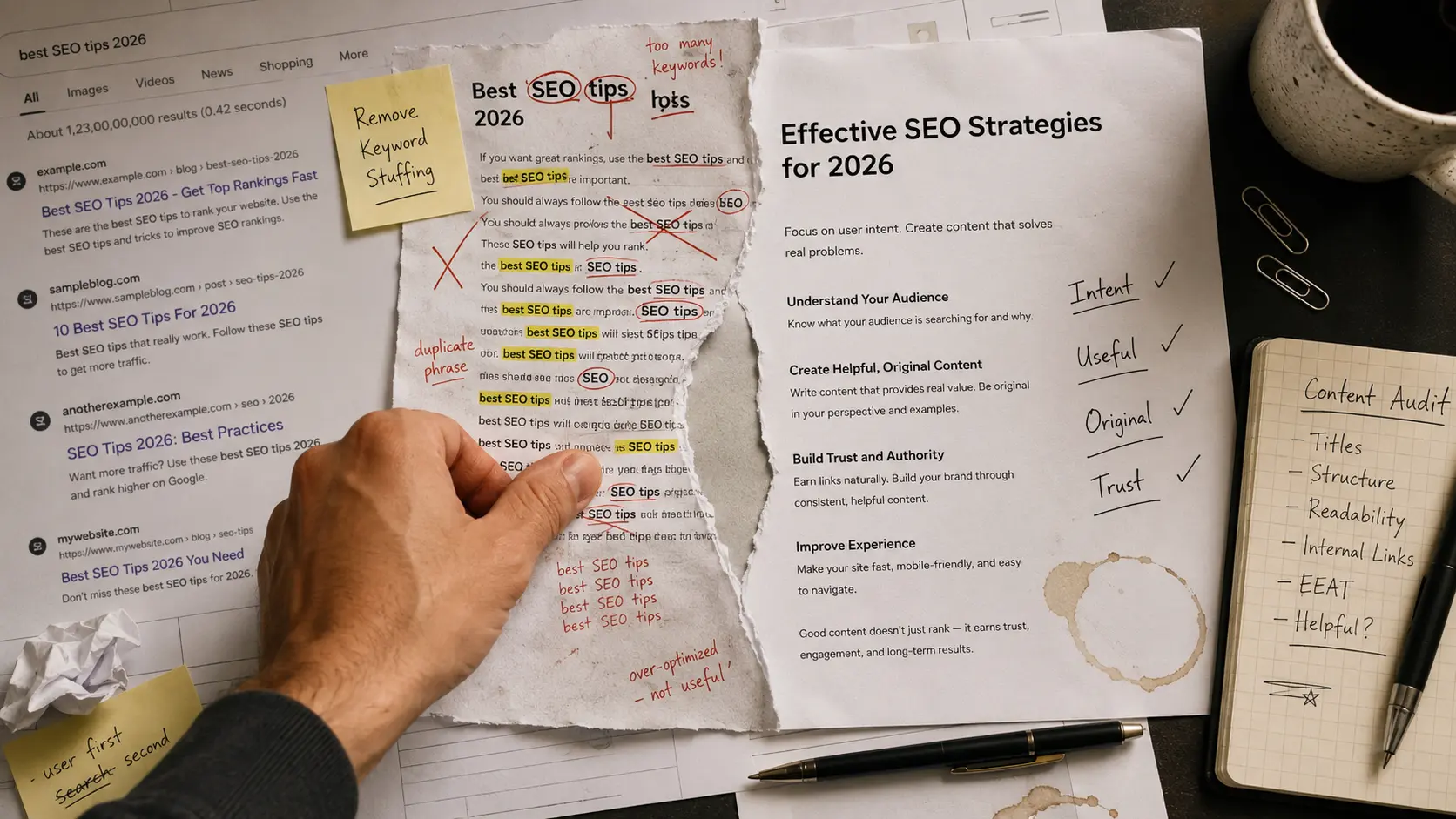
If your website traffic suddenly drops, it is easy to assume that Google has penalized your site. But a traffic decline does not always mean you have received a penalty. Search rankings can change because of algorithm updates, technical problems, indexing issues, seasonal demand, tracking errors, or changes in how Google understands search intent.
The Google algorithm update 2026 landscape makes one thing increasingly important: sustainable SEO cannot depend on repeating the same keyword dozens of times. Google has continued releasing core and spam updates during 2026, while its search experience is also evolving through AI features.
For businesses, the better approach is to create useful content, understand what users actually want, maintain a technically healthy website, and build genuine topical authority. This guide explains how to identify potential SEO problems, recover from traffic drops, avoid keyword stuffing, and prepare your website for modern search and AI-powered experiences.
What Does the Google Algorithm Update 2026 Mean for SEO?
Google algorithm updates are changes to the systems Google uses to understand, evaluate, and rank content in Search. Some updates are broad core updates, while others focus on spam or particular search experiences.
In 2026, Google's official Search Status Dashboard lists multiple confirmed ranking updates, including the March 2026 core update, May 2026 core update, March and June spam updates, and August 2026 spam update.
That does not mean every ranking change is caused by an algorithm update.
A website can lose organic traffic because of:
- A confirmed Google update
- Technical SEO problems
- Indexing or crawling issues
- Seasonal changes in search demand
- Changes in competitors' content
- Tracking or analytics problems
- Manual actions
- Normal ranking volatility
This distinction matters. If you immediately rewrite your entire website after a traffic decline, you may make it harder to understand what actually caused the problem.
Google's Search Essentials emphasize people-first content, technical accessibility, and avoiding spam practices. Meeting those requirements does not guarantee rankings, but they provide a sensible foundation for sustainable SEO.
Why Quality Matters More Than Keyword Stuffing
Keyword stuffing means placing keywords or keyword variations on a page excessively or unnaturally in an attempt to influence rankings.
For example, imagine a local business writes:
The phrase may contain the target keyword, but the sentence is repetitive and unnatural. It does not tell the reader anything useful.
A better version would be:
The second version communicates an idea rather than trying to repeat a phrase.
Google's current guidance focuses on helpful, reliable, people-first content rather than mechanical keyword repetition. Its spam policies also identify large amounts of low-value content created primarily to manipulate rankings as a form of scaled content abuse.
That is why modern SEO should focus on:
- Search intent
- Topic coverage
- Natural language
- Original information
- Useful examples
- Clear structure
The principle is simple: Topic coverage is more important than keyword frequency.
3 Signs Your Website May Be Over-Optimized
1. Your Content Sounds Robotic
If the same phrase appears in nearly every sentence, readers notice it immediately. Good SEO copy should sound natural when read aloud. If removing the keywords makes the sentence dramatically better, the page may be over-optimized.
2. Your Headings Exist Mainly to Target Keywords
Headings should help readers understand the page. Instead of creating several headings that are minor variations of the same keyword, use headings that reflect the questions and problems your audience actually has.
For example:
Weak: “SEO Company Madurai SEO Services Madurai”
Better: “How Can a Local Business Improve Its Search Visibility?”
3. Your Website Contains Manipulative or Unnecessary SEO Elements
Watch for practices such as hidden text, irrelevant content, excessive exact-match wording, doorway-style pages, and misleading structured data.
Structured data itself should not be treated as a ranking penalty. When used correctly, it helps search engines understand the content of a page. The important point is that the markup should accurately represent what is actually on the page.
What Is AEO and Why Does It Matter in 2026?
Answer Engine Optimization (AEO) is the practice of structuring useful information so that it can be easily understood and surfaced in answer-focused search experiences. It emphasizes direct answers, clear explanations, question-based content, structured information, and trustworthy sources.
AEO becomes increasingly relevant as users search conversationally and interact with AI-powered experiences. Instead of only searching “SEO traffic drop”, a user might ask: “Why did my website traffic suddenly drop after a Google update?”
A strong AEO-friendly page should answer that question directly before expanding into supporting details.
How to Recover From an SEO Traffic Drop
A traffic decline should be investigated systematically.
Step 1 — Check Whether Google Confirmed an Update
Start by checking Google's Search Status Dashboard. If a confirmed update overlaps with the date your traffic changed, that is useful context. But correlation does not automatically prove that the update caused the decline.
Step 2 — Audit Your Content
Review the pages that lost visibility. Ask: Does the page satisfy the search intent? Is the information original? Is it actually useful? Has anything become outdated? Do not rewrite content simply because a keyword appears fewer times than expected. Rewrite it when the content can genuinely become more useful.
Step 3 — Remove Keyword Stuffing
Replace repetitive keywords with natural language, synonyms, related concepts, user questions, contextual explanations, and specific examples.
Step 4 — Improve E-E-A-T Signals
Strong content should demonstrate real experience and expertise where appropriate. Consider first-hand experience, subject expertise, transparent authorship, trustworthy references, and accurate business information.
Step 5 — Improve Technical SEO
Review indexing, crawlability, page experience, mobile usability, internal links, canonicalization, structured data, and broken links.
Step 6 — Monitor Before Making More Changes
Avoid changing 20 things at once. If you change titles, content, internal links, URLs, schema, navigation, and technical settings simultaneously, you may not know which change helped or hurt.
Practical Example — From Over-Optimized Content to Helpful Content
Before: A fictional local agency has a service page targeting “digital marketing agency in Madurai.” The page repeats the exact phrase throughout the headings, paragraphs, image alt text, and calls to action. Several headings are simply variations of the same keyword.
After: The agency restructures the page around user intent. The new version explains which digital marketing services are available, which types of businesses may benefit, how the strategy works, and how performance can be measured. The keyword still appears naturally, but it is no longer the organizing principle of every sentence.
When Should You Consider Professional SEO Help?
Professional SEO support can be useful when your team is struggling to identify why organic performance has changed or when the website has grown beyond what can be managed casually. Consider an SEO audit if you are experiencing a significant unexplained traffic decline, technical SEO problems, indexing issues, or poor local visibility.
For businesses looking for professional support, Hooks Tech provides SEO services through our Best SEO Company in Madurai packages.
Frequently Asked Questions
Conclusion
The biggest lesson from the Google algorithm update 2026 landscape is not that businesses need another keyword trick. It is that sustainable SEO depends on creating genuinely useful websites.
Keyword stuffing may look like optimization, but excessive repetition does not replace relevance, expertise, useful information, or good technical foundations. If your traffic has declined, diagnose the cause before making major changes. Check confirmed updates, review technical health, audit content, understand search intent, and improve pages where they genuinely fall short.
Start with one practical step: audit your most important pages and identify where you can make them clearer, more useful, and more trustworthy.

Written by Hooks Tech Team
Digital Marketing Experts in Madurai
Hooks Tech is a digital marketing brand focused on practical SEO, AEO, and digital marketing strategies. The team approaches search optimization with an emphasis on useful content, technical quality, ethical practices, and sustainable growth rather than short-term ranking tricks.
Stay Updated
Get the latest SEO tips and digital marketing insights delivered to your inbox.
Grow Your Business
Need help with your SEO strategy? Our experts are here to assist you.
Get Free Audit