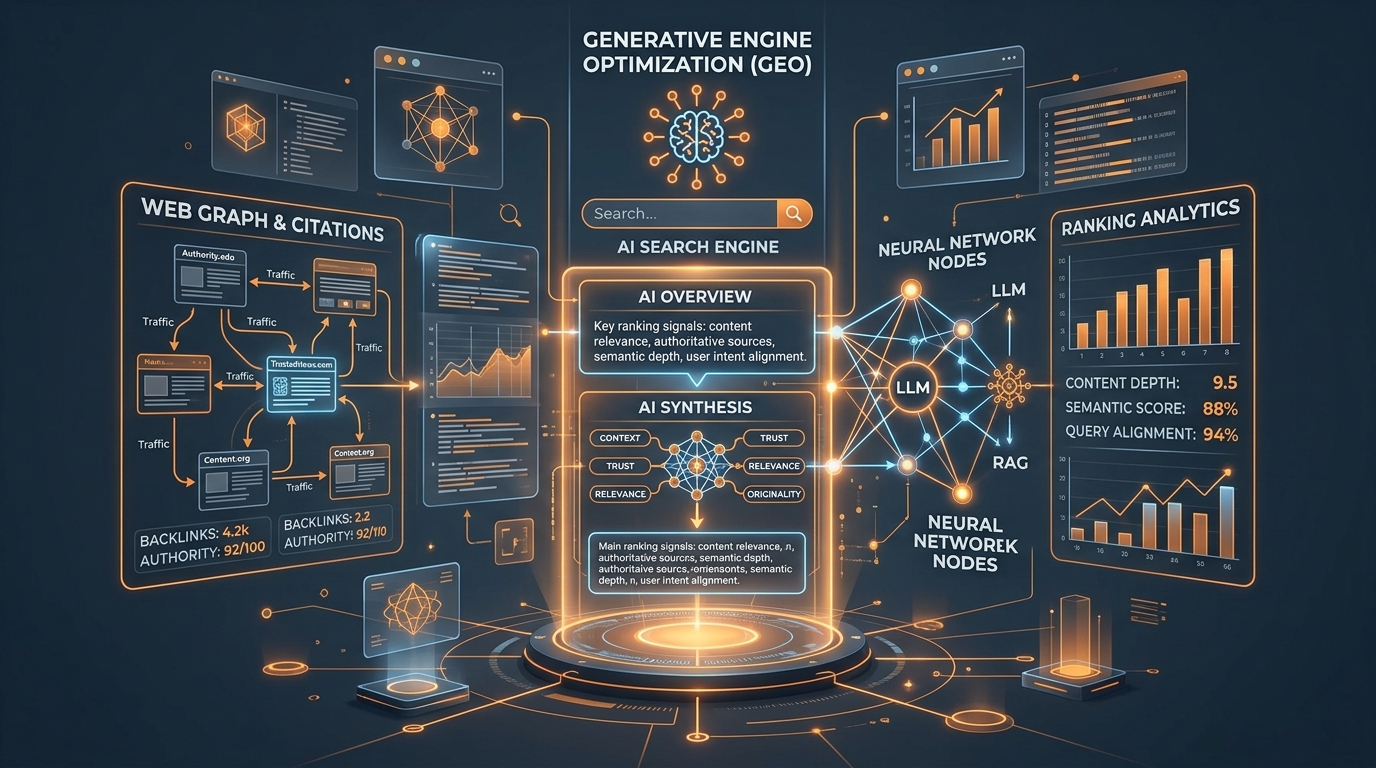
 Generative Engine Optimization (GEO)
Direct Answer for AI Overviews & Readers
To rank in Google AI Overviews, ChatGPT Search, and Perplexity AI in 2026, websites must transition from keyword repetition to Generative Engine Optimization (GEO). AI models use Retrieval-Augmented Generation (RAG) to cite sources demonstrating: (1) High information gain with direct answer blocks, (2) Verifiable entity authority and consistent local citations, (3) Robust JSON-LD schema markup (Organization, LocalBusiness, FAQPage), and (4) Transparent, honest claims without manipulative guarantees.
Table of Contents
- 1. The Major Shift: From 10 Blue Links to AI Synthesis Engines
- 2. How Google AI Overviews & Chat Engines Select Sources
- 3. The 5 Core Pillars of Generative Engine Optimization (GEO)
- 4. Traditional SEO vs. Generative Engine Optimization (Comparison Table)
- 5. Why "Trust & Transparency" is the #1 AI Ranking Signal in 2026
- 6. The Local Business Advantage: Dominating Regional AI Searches in Madurai & Tamil Nadu
- 7. The 2026 Actionable GEO Implementation Checklist
- 8. Frequently Asked Questions (FAQ)
1. The Major Shift: From 10 Blue Links to AI Synthesis Engines
For over two decades, search engine optimization was straightforward: identify target keywords, optimize title tags, earn backlinks, and climb into Google's top 10 organic results. In 2026, that landscape has fundamentally transformed.
With the global rollout of Google AI Overviews (powered by Gemini), the rise of ChatGPT Search, and conversational discovery platforms like Perplexity AI, users no longer click through five different websites to piece together an answer. Instead, generative search engines extract, summarize, and cross-reference information in milliseconds, presenting a synthesized response with clickable citation cards.
If your brand is not chosen as one of those primary citations, your organic visibility plummets—even if your page sits on position #2 of traditional search results. To survive and thrive, businesses must master Generative Engine Optimization (GEO).
2. How Google AI Overviews & Chat Engines Select Sources
Unlike traditional crawlers that match keyword strings against webpage indexes, generative search engines use Retrieval-Augmented Generation (RAG). When a user submits a query, the AI engine executes a three-phase pipeline:
Phase 1: Retrieval
The engine scans its semantic knowledge graph and live web index for pages with high topical depth.
Phase 2: Fact Verification
The AI filters out repetitive spam, conflicting claims, and unverified data using consensus algorithms.
Phase 3: Synthesis & Citation
The model extracts the clearest, most structured snippets and awards the primary citation links.
3. The 5 Core Pillars of Generative Engine Optimization (GEO)
Based on extensive testing across Google AI Overviews, ChatGPT Search, and Perplexity, Hooks Tech has identified five foundational pillars that determine whether an AI engine will cite your website:
Pillar 1: High Information Gain & Direct Answer Formats
Google's patented Information Gain metric measures how much new, non-redundant value a webpage brings compared to documents already in its index. If your blog rehashes generic Wikipedia paragraphs, an AI engine has zero reason to cite you.
Use "Answer-First" formatting: immediately answer the core question in the first 40–60 words beneath each H2 or H3 heading, followed by nuanced supporting context, bullet points, and real-world examples.
Pillar 2: Entity-First Brand Authority
Generative engines do not think in terms of keywords—they think in terms of entities (people, places, organizations, concepts) and the semantic relationships between them.
At Hooks Tech, we ensure your brand entity is clearly defined in Google's Knowledge Graph by maintaining unified business profiles, local Madurai address verification, consistent founder bios, and unambiguous industry classifications.
Pillar 3: Semantic Schema Architecture (JSON-LD)
Large Language Models excel at reading structured data. When your website provides comprehensive JSON-LD schemas—including Organization, LocalBusiness, FAQPage, Article, and BreadcrumbList—you eliminate ambiguity and hand the AI verified facts on a silver platter.
Pillar 4: Verifiable Claims & Realistic Scope
One of the quickest ways to be filtered out of an AI Overview is making unsupported superlatives. If a website claims "We are the only 100% guaranteed #1 SEO agency in India," AI fact-checking systems flag it as low-credibility marketing fluff.
Conversely, when a brand states transparently—as Hooks Tech does—that "No responsible SEO provider can guarantee a specific Google ranking; rather, we execute structured, data-driven optimization aligned with your goals," search engines recognize genuine E-E-A-T (Experience, Expertise, Authoritativeness, and Trustworthiness).
Pillar 5: Multi-Source Web Consensus
ChatGPT and Perplexity do not rely on your website alone. They cross-examine external references: directory listings, local Tamil Nadu business chambers, verified client case reviews, LinkedIn company pages, and social media activity. A cohesive multi-channel presence creates the consensus AI models require before recommending you to a customer.
4. Traditional SEO vs. Generative Engine Optimization (GEO)
To illustrate the paradigm shift, review how traditional SEO practices compare directly with 2026 Generative Engine Optimization:
| Evaluation Factor | Traditional SEO (Pre-2025) | Generative Engine Optimization (2026) |
|---|---|---|
| Primary Objective | Achieve a top 10 blue link ranking | Earn the primary citation in AI-synthesized summaries |
| Content Strategy | Keyword density & word count bloat | High Information Gain, structured tables & direct answers |
| Core Algorithm | PageRank & string-based indexing | Retrieval-Augmented Generation (RAG) & Knowledge Graphs |
| Trust Evaluation | Raw backlink quantity | Entity authority, unbiased facts & real business E-E-A-T |
| Local Visibility | Keyword stuffing city names into H1s | Real Madurai / Tamil Nadu business context, verified NAP & schema |
| Conversion Metric | Organic click-through rate (CTR) | High-intent referral clicks from qualified AI citations |
5. Why "Trust & Transparency" is the #1 AI Ranking Signal in 2026
Generative AI engines have an inherent vulnerability: hallucination. To protect their users and reputations, platforms like Google, OpenAI, and Anthropic have aggressively tuned their citation filters to discard sites that display red flags.
What are those red flags?
- Exaggerated, unsubstantiated claims ("10,000 leads in 24 hours guaranteed").
- Anonymous author profiles with no verifiable professional history.
- Generic, copied content that adds zero original perspective or data.
- Inconsistent contact information or vague geographical identities.
This is why our recent homepage revamp at Hooks Tech prioritized honest business foundations: clear scope, upfront communication, business-first recommendations, and verified project deliverables. When search algorithms evaluate a site that openly communicates its working methodology and respects customer intelligence, that site earns an insurmountable trust advantage.
6. The Local Business Advantage: Dominating Regional AI Searches in Madurai & Tamil Nadu
There is widespread misconception that small and regional businesses cannot compete in AI search against massive aggregators like JustDial, Sulekha, or generic global blogs.
In reality, the exact opposite is true.
When a prospect in Madurai asks an AI: "Which digital marketing company in Madurai offers customized SEO and web development with transparent pricing?", the AI model looks for hyper-local entity depth:
Verified Madurai Entity Signals
Consistent location data (Nelpettai, Madurai - 625001), real geo-coordinates, Tamil Nadu regional service landing pages, and local client work contexts.
Practical Working Relationships
Documented project deliveries across local sectors like hospitality (Era Resorts), construction (SEYON Construction), and creative studios (Flashy Shots).
7. The 2026 Actionable GEO Implementation Checklist
Want to ensure your website is primed for Google AI Overviews and chat search engines? Follow this step-by-step checklist recommended by Hooks Tech:
Review your top 10 articles. If a paragraph doesn't offer unique insight, data, or practical advice, rewrite or replace it.
Add validated WebSite, Organization, LocalBusiness, FAQPage, and Article schemas matching your visible page text.
Create concise 40-word definition summaries at the start of major topics so AI scrapers can easily extract snippets.
Use responsive HTML tables to contrast strategies, pricing models, and service scopes. LLMs prioritize tables for direct synthesis.
Replace generic marketing promises with grounded explanations of your process, scope, and evaluation metrics.
Keep your Name, Address, Phone (NAP), Google Business Profile, and regional service pages completely synchronized.
8. Frequently Asked Questions (FAQ)

Written by the Hooks Tech Strategy Team
Digital Strategy, SEO & Marketing Automation Specialists
Based in Madurai, Tamil Nadu, Hooks Tech helps startups and growing businesses build authentic online presence, high-performance websites, and data-backed digital growth strategies tailored for the modern AI search era.
Google Algorithm Update 2026: Why Quality Beats Keyword Stuffing →
Is Your Site AI Search Ready?
Get your website evaluated for Google AI Overviews, ChatGPT Search, and modern GEO signals by the Hooks Tech team.
Request GEO AuditOur Core Services
Partner With Hooks Tech
Clear communication • Tailored strategies • Madurai, Tamil Nadu
Chat With Our Team