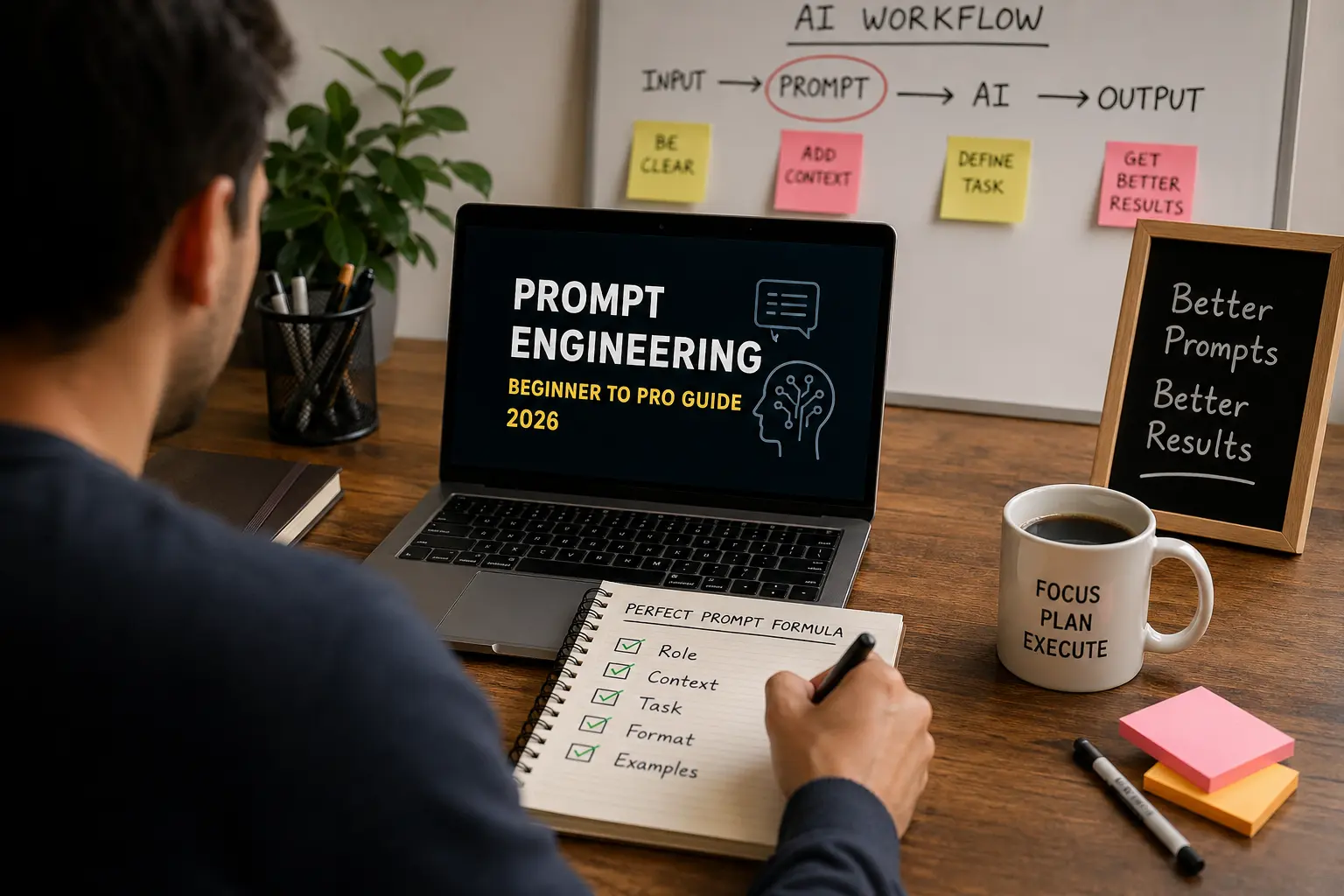
AI tools are everywhere right now but here's the problem: most people still use them badly. They type vague prompts, get average results, and assume AI is "limited."
In reality, the difference between a weak output and a powerful one often comes down to how you ask. That's where prompt engineering comes in.
Whether you're using ChatGPT, Gemini, or any other AI tool, the quality of your prompts directly controls the quality of your results.
In this guide, you'll learn:
- What prompt engineering really means
- How it works behind the scenes
- Practical techniques you can use today
- Advanced strategies used by professionals
By the end, you won't just "use AI" you'll control it.
What Is Prompt Engineering?
Prompt engineering is the process of designing and structuring inputs (prompts) to get better, more accurate, and more useful outputs from AI systems.
Simple Meaning
At its core:
- A prompt = what you ask AI
- Prompt engineering = how you ask it intelligently
"Write a blog about SEO."
A prompt engineer does this:
"Act as an SEO expert. Write a 1500-word blog post targeting beginners. Include headings, examples, and actionable tips."
See the difference? One is vague. The other gives direction, context, and structure.
Beginner-Friendly Example
Bad prompt:
"Give me Instagram captions."
Better prompt:
"Create 10 engaging Instagram captions for a fitness brand
targeting beginners, using a motivational tone and including call-to-actions."
Same tool. Completely different outcome.
Why Prompt Engineering Matters in 2026
AI isn't just a tool anymore it's becoming the interface to search, work, and decision-making.
If you've read about How to Rank in ChatGPT, you already know that AI-generated answers are replacing traditional search results.
What Changed?
- People ask AI instead of Google
- AI summarizes instead of listing links
- Businesses compete to be included in AI answers
Where Prompt Engineering Fits In
Prompt engineering impacts:
- SEO workflows
- Content creation
- Customer support automation
- Coding productivity
- Marketing campaigns
A well-written prompt can:
- Cut hours of work
- Improve accuracy
- Generate higher-quality outputs
- Reduce editing time
Real-World Impact
A marketer using basic prompts might take 3 hours to write a blog. A skilled prompt engineer:
- Generates a structured draft in 5 minutes
- Edits in 20 minutes
- Publishes faster
That's not a small improvement, that's a competitive edge.
How Prompt Engineering Actually Works
To understand prompt engineering deeply, you need to understand how AI interprets your input. AI doesn't "think." It predicts patterns based on your instructions.
1. Role Prompting
You assign a role to the AI.
Example: "Act as a senior SEO strategist..."
This helps the AI choose tone, apply domain knowledge, and structure answers properly.
2. Context Prompting
You provide background information.
Example: "This article is for beginners learning digital marketing."
More context = better relevance.
3. Instruction Clarity
Clear instructions remove ambiguity.
- Weak: "Write about marketing."
- Strong: "Write a beginner-friendly guide on email marketing with examples and steps."
4. Output Formatting
Tell AI exactly how to present the answer.
- Bullet points
- Numbered steps
- Tables
- Headings
5. Iteration (The Hidden Skill)
Most people stop after one prompt. Experts refine, tweak, and improve. Prompt engineering is iterative, not one-shot.
Best Prompt Engineering Techniques
Here are techniques that actually work in real workflows.
1. The "Role + Task + Format" Formula
"Act as [role]. Perform [task]. Format it as [structure]."
Example: "Act as a content strategist. Create a blog outline on AI SEO. Format it with H2 and H3 headings."
2. Few-Shot Prompting
Give examples.
Example: "Here are 2 captions. Create 5 more in the same style."
This dramatically improves output quality.
3. Constraint-Based Prompts
Add limits like word count, tone, audience, and structure.
4. Chain Prompting
Break tasks into steps. Instead of asking to "Write a blog," do:
- Generate outline
- Expand sections
- Optimize SEO
Better results, less confusion.
5. Persona Prompting
Create a specific voice.
Example: "Write like a startup founder explaining to investors."
Google Gemini Prompt Techniques
Gemini works slightly differently compared to ChatGPT.
Key Differences
- Gemini is more context-aware
- It integrates better with Google ecosystem
- It prefers structured prompts
Gemini Prompt Example
"Summarize this article in 5 bullet points and highlight key SEO strategies."
Gemini Strategy Tips
- Be explicit
- Use structured requests
- Ask for comparisons
- Use follow-up prompts
ChatGPT vs Gemini Prompting
| Feature | ChatGPT | Gemini |
|---|---|---|
| Creativity | High | Moderate |
| Structure | Needs guidance | Better by default |
| Context use | Strong | Very strong |
| Best for | Content | Research + summaries |
Prompt Engineering Examples for Beginners
Let's make this practical.
- Blog Writing: "Act as an SEO expert. Write a 1500-word blog on 'AI in digital marketing' targeting beginners. Include headings and examples."
- SEO Optimization: "Analyze this article and suggest improvements for SEO, readability, and keyword usage."
- Coding: "Write a Python script that extracts emails from a text file and saves them into a CSV."
- Social Media: "Create 10 viral Twitter posts about AI tools for entrepreneurs."
- Email Writing: "Write a professional cold email for a digital marketing service targeting small businesses."
- Business Workflow: "Create a step-by-step workflow for onboarding new clients in a marketing agency."
If you're running or planning to work with a Digital marketing agency in Madurai, these workflows can drastically improve team productivity.
Advanced Prompt Engineering Strategies
Once you're comfortable with basics, this is where things get interesting.
1. Prompt Chaining
Link multiple prompts together. Example: Prompt 1 (Research) → Prompt 2 (Outline) → Prompt 3 (Write) → Prompt 4 (Optimize)
2. Multi-Step Reasoning
Ask AI to think step-by-step: "Explain your reasoning step by step." Useful for problem solving, analysis, and decision-making.
3. AI Workflow Systems
Combine tools like ChatGPT, Gemini, and automation tools to create content pipelines and automated marketing systems.
4. Dynamic Prompts
Use variables (audience, niche, tone) to scale content. This is how agencies scale content.
Common Prompt Engineering Mistakes
Most beginners make the same mistakes.
- 1. Being Too Vague: AI can't read your mind.
- 2. No Context: Without context, outputs are generic.
- 3. Expecting Perfect Output: AI needs refinement.
- 4. Ignoring Format: Unstructured prompts = messy outputs.
- 5. Not Iterating: The best results come after tweaking.
Best AI Tools for Prompt Engineering
Here are the tools worth using in 2026:
- ChatGPT
- Google Gemini
- Claude
- Perplexity
- Midjourney
For deeper insights into AI capabilities, even organizations like OpenAI and research platforms discussed by Stanford University AI Index highlight how prompt quality directly impacts model performance.
Future of Prompt Engineering
Prompt engineering isn't going away-it's evolving.
What's Coming
- AI-first search engines
- Voice-based prompting
- Automation workflows
- AI agents
If you explore Upcoming Digital Marketing Trend, you'll see prompt engineering sitting at the center of it all.
Career Perspective
- Prompt engineers are in demand
- Marketers are learning AI workflows
- Freelancers are using prompts to scale work
This isn't just a skill-it's becoming a core digital competency.
Frequently Asked Questions (FAQ)
Prompt engineering is one of those skills that feels simple at first-but becomes incredibly powerful once you understand it. The gap between average users and skilled users isn't the tool. It's the prompt.
Start small: improve your prompts daily, experiment, and refine. Over time, you'll notice something interesting: You're not just using AI anymore. You're directing it.

Written by Hooks Tech Team
Digital Marketing Experts in Madurai
Hooks Tech is a leading digital marketing agency helping businesses in Tamil Nadu grow through data-driven strategies and creative innovation.
Stay Updated
Get the latest SEO tips and digital marketing insights delivered to your inbox.
Grow Your Business
Need help with your SEO strategy? Our experts are here to assist you.
Get Free Audit